Why Doctors Dismiss Perimenopause as "Just Stress" (And What the Data Says About Why)
For educational purposes only — this article is not a substitute for professional medical advice, diagnosis, or treatment.
You describe what's happening — the sleep that won't come, the irritability that feels foreign to you, the sense of dread that shows up for no reason — and the appointment ends with a prescription for an SSRI and a suggestion to try meditation. No mention of perimenopause. No questions about your cycle. Just: this sounds like anxiety.
It might be anxiety. It might also be perimenopause presenting exactly the way perimenopause tends to present. The trouble is that, for a striking number of women, nobody stops to ask which.
Key takeaways
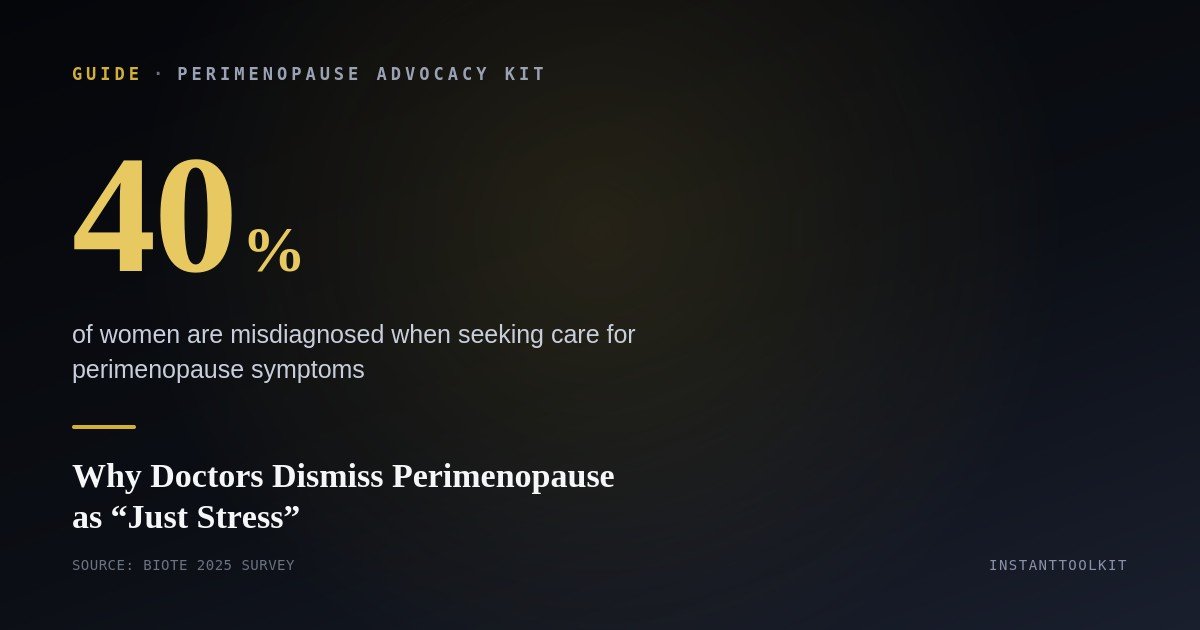
- A 2025 survey of over 1,000 US women found nearly 40% were misdiagnosed when seeking perimenopause care, and more than half of those were treated for anxiety, depression, or panic symptoms instead.
- The overlap isn't a coincidence — declining and fluctuating estrogen directly affects the same neurotransmitter systems (serotonin, GABA, dopamine) implicated in anxiety and depression.
- Fewer than 20% of primary care physicians receive formal menopause training, which helps explain why the mental-health explanation is often reached for first.
- Getting misdiagnosed isn't a minor detour — women in this position often wait years and see multiple providers before the underlying pattern is recognized.
How common is this, really?
A 2025 national survey of more than 1,000 US women, conducted by Biote, found that nearly 40% of women reported being misdiagnosed when they sought care specifically for perimenopause symptoms. Of that group, more than half said they were treated for anxiety, depression, mood swings, or panic attacks instead — and one in three received an anxiety diagnosis specifically. Among the women who ended up on medication for a mental health condition as a result, 39% said they believed, in hindsight, that they had not received the correct diagnosis at all.
This tracks with broader findings on how often perimenopause goes unnamed in the first place. A separate analysis published by the American Journal of Managed Care found that 25% of women aged 50 to 65 had never once been told by a doctor — primary care physician or OB/GYN — that they were in perimenopause or menopause, despite 92% of respondents having experienced at least one menopause-related symptom in the past year. Four in ten said those symptoms interfered with their work performance on a weekly basis.
The biology behind the overlap
The mental-health explanation isn't pulled from nowhere. Perimenopause and anxiety or depression genuinely do share overlapping machinery in the brain, which is part of why the two get conflated so easily.
Estrogen isn't only a reproductive hormone — it acts throughout the central nervous system as a modulator of several neurotransmitter systems tied directly to mood. Peer-reviewed research summarized in integrative reviews on menopausal mood changes describes estrogen as influencing serotonin synthesis, receptor sensitivity, and reuptake, as well as GABA receptor activity, the brain's primary calming pathway. As estrogen fluctuates and eventually declines during the menopausal transition, this can disrupt serotonergic signaling in brain regions involved in emotional regulation, including the prefrontal cortex and limbic system.
There's a second mechanism layered on top of this: estrogen normally has a dampening effect on the body's stress-response system (the hypothalamic-pituitary-adrenal, or HPA, axis). As estrogen becomes less stable, that dampening effect weakens, which can leave the body running with a higher baseline of physiological arousal — a state that feels a great deal like anxiety, because in a very real sense, it overlaps with it.
Add in the sleep disruption that hot flashes and night sweats commonly cause, and you have a symptom cluster — poor sleep, irritability, racing thoughts, low mood — that is genuinely difficult to distinguish from a primary mood disorder from a symptom checklist alone. That's precisely why it so often isn't distinguished, and why the default lands on the diagnosis that's more familiar to treat.
Why the default lands on "stress" or "anxiety"
The overlap explains why misdiagnosis is possible. It doesn't fully explain why it's so common. That part is more structural than biological.
Fewer than 20% of primary care physicians receive formal training in menopause care, according to The Menopause Society. A peer-reviewed study published in MedEdPORTAL found that up to 70% of fourth-year OB/GYN residents report discomfort managing menopause-related concerns, and more than 90% of postgraduate trainees across internal medicine, family medicine, and OB/GYN report feeling unprepared to manage menopausal patients. Separately, a 2023 survey of US OB/GYN residency directors, published in the journal Menopause, found that 92.9% agreed residents should have access to a standardized menopause curriculum — while only 31.3% of programs actually had one in place.
In a fifteen-minute appointment, a clinician working from a mental-health framework has a fast, well-rehearsed path forward: name the mood symptom, prescribe accordingly, schedule a follow-up. Naming perimenopause as a contributing factor requires a different, less-practiced set of questions — about cycle changes, hot flashes, sleep, and timing — that many providers simply weren't trained to ask first.
What getting it wrong actually costs
Misdiagnosis here isn't a small inconvenience. Research from Newson Health Research and Education, surveying 5,000 women, found that a third wait at least three years for their symptoms to be correctly identified as menopause-related, and 18% saw a doctor an average of six times before getting the help they needed. A UK government survey of nearly 100,000 women found that 91% did not feel they'd been given enough information about menopause, and over a third felt uncomfortable even raising the subject with a healthcare professional.
Years spent on a mental-health treatment plan that only partially addresses what's happening — while the underlying hormonal pattern goes unaddressed — is a real cost, not a hypothetical one.
How to tell the difference isn't always obvious — but a few patterns help
None of this is a substitute for a clinical evaluation, and mood symptoms should always be taken seriously regardless of their cause. But a few patterns are worth paying attention to before an appointment, and worth mentioning explicitly once you're in one:
- Timing. Perimenopause-linked mood changes often surge and recede in a way that tracks with cycle changes, rather than staying constant day to day.
- Clustering. If the mood symptoms are showing up alongside physical ones — new hot flashes, sleep disruption, cycle changes, joint pain — that combination points toward a hormonal contributor worth asking about directly, rather than a mood symptom in isolation.
- Onset. A mood pattern that feels genuinely new, with no real prior history of anxiety or depression, arriving in your late 30s through 40s, is exactly the profile perimenopause-linked mood change tends to follow.
None of these confirm anything on their own. What they're useful for is giving you specific, concrete language to bring into the room — instead of a general description that's easy for a rushed appointment to file under the more familiar diagnosis.
What actually helps in the appointment
The most effective thing you can bring to that conversation isn't a stronger argument — it's a clearer, dated record of the full pattern: mood alongside sleep, cycle changes, hot flashes, and timing, tracked over weeks rather than described from memory in the moment.
That's exactly what The Perimenopause Advocacy Kit is built to produce: a 90-day tracker that logs mood alongside 30+ other recognized symptoms, a one-page summary that puts the full pattern in front of your doctor in the first minute, and a script — built specifically for the moment you hear "it's just stress" — that asks your doctor to consider both explanations rather than defaulting to one. It doesn't diagnose you, and it doesn't replace a mental health evaluation where one is genuinely needed. It just makes sure the full picture, not just the mood symptom, is what gets discussed.
If what you're feeling doesn't fully match what you're being treated for, that mismatch is worth naming out loud — to yourself first, and then to your doctor.
