Am I Too Young for Perimenopause? Here's What the Research Actually Says
If you've brought up symptoms like irregular periods, sudden mood swings, or nights you can't explain to your doctor and heard some version of “you're too young for that,” you're not alone — and you're very possibly not too young at all.
For educational purposes only — this article is not a substitute for professional medical advice, diagnosis, or treatment.
What the research actually shows
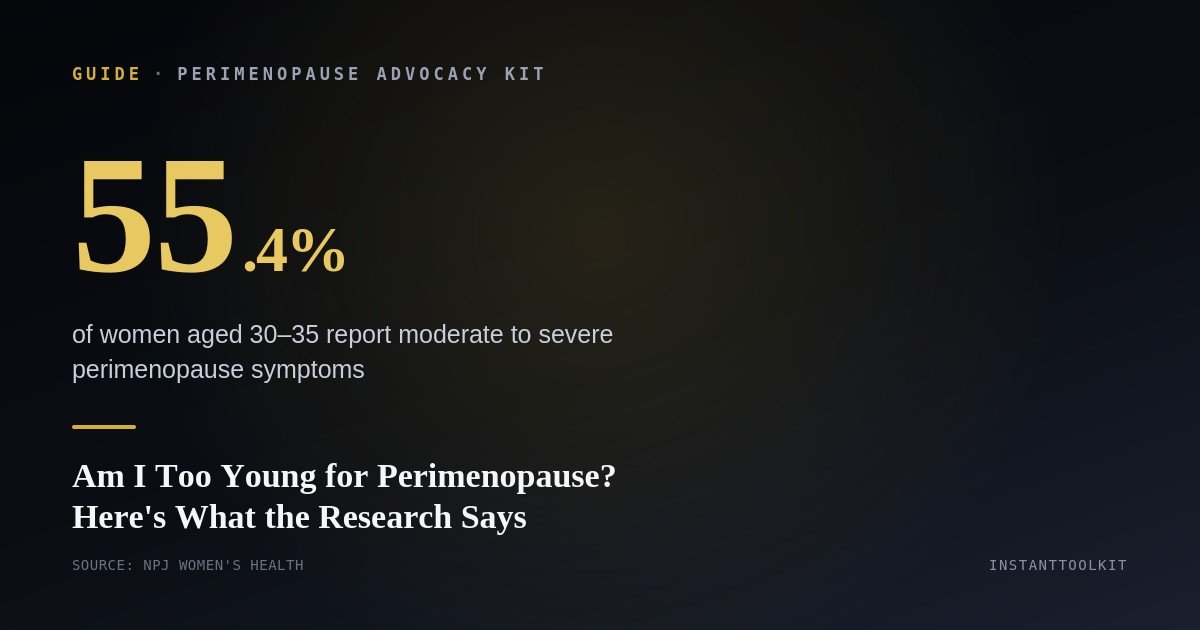
Perimenopause — the hormonal transition leading up to menopause — is widely assumed to start in a woman's late 40s. In practice, it starts much earlier for a large share of women. A recent study published in npj Women's Health, analyzing self-reported data from over 4,400 women, found that 55.4% of women aged 30 to 35 reported moderate to severe perimenopause symptoms. Among women aged 36 to 40, that figure rose to 64.3%.
Despite this, the same research found that most women don't receive treatment for their symptoms until age 56 or older — often two decades after symptoms began. The gap between when symptoms start and when they're taken seriously is exactly where “you're too young for that” tends to live.
Why the dismissal happens in the first place
This isn't usually about a doctor not believing you. It's more often a training gap. Fewer than 20% of primary care physicians receive formal menopause education, according to The Menopause Society, and a peer-reviewed study published in MedEdPORTAL found that up to 70% of fourth-year OB/GYN residents report discomfort managing menopause-related care, with more than 90% of postgraduate trainees across internal medicine, family medicine, and OB/GYN saying they feel unprepared to manage menopausal patients.
Put simply: many clinicians associate perimenopause with a specific age range because that's largely what their training covered — not because symptoms in the 30s and early 40s aren't real.
What counts as “early” perimenopause
Perimenopause can begin any time from the mid-30s onward, and the transition typically lasts four to five years before menopause itself, though for some women it runs shorter or considerably longer. Commonly reported early symptoms include:
- Cycle changes — periods becoming shorter, longer, heavier, or less predictable
- New or worsening sleep disruption
- Mood changes that feel different from your usual baseline — irritability, anxiety, or low mood
- Brain fog or word-finding trouble
- Hot flashes or night sweats, even if occasional
- New joint pain, headaches, or heart palpitations
None of these symptoms are unique to perimenopause — several can have other causes, which is exactly why a clinician should be the one interpreting them. But they also aren't reasons to be waved off without a real conversation, regardless of your age.
What actually helps in the appointment
The single biggest shift patients can make isn't finding a way to sound more convincing — it's bringing something more concrete than a description. A dated, structured record of what you've been experiencing is harder to attribute to “probably nothing” than a verbal summary given in a rushed fifteen-minute slot.
That's the entire idea behind The Perimenopause Advocacy Kit: a 90-day symptom tracker, a one-page doctor visit summary, and word-for-word scripts for the moments — including “you're too young for that” — where these conversations tend to go sideways. It doesn't diagnose or recommend treatment. It just makes sure your data gets seen.
If you're in your early 30s and something feels different, you're allowed to take that seriously — and so is your doctor.
